Quick Summary
Ash dieback has changed how landowners and homeowners think about ash trees. The key is spotting the signs early before a tree becomes a safety risk.
Ash dieback has become one of the biggest tree management issues across the South East. The ash dieback service page covers how we approach affected trees, from assessment through to safe removal. It affects ash trees of all sizes, from boundary trees in domestic gardens to larger groups on estates, farms, and roadside land. For many people, the hardest part is knowing when an ash tree has moved from "something to keep an eye on" to "something that now needs dealing with".
That matters because ash dieback is not just a disease story. It is a safety story as well. Once an infected tree begins to decline, its timber can become far less reliable than people expect.
What ash dieback means in practical terms
Most homeowners are not interested in the Latin name of the disease. They want to know whether the tree is becoming unsafe, whether it needs work, and whether the problem is likely to get worse.
In practical terms, ash dieback can lead to:
- thinning or dying crowns
- dead shoots and branch tips
- weakness in the upper canopy
- brittle timber
- a general decline that can speed up over time
Some trees linger for years. Others deteriorate faster. That variation is part of what makes assessment important.
The first signs people usually notice
Many customers first spot the problem because the tree simply looks wrong compared with previous years.
Common warning signs include:
- a thinning canopy during the growing season
- dead twigs and branches in the crown
- premature leaf loss
- dark lesions or damaged-looking patches on younger growth
- vigorous shoots appearing lower down the trunk as the tree struggles
Not every struggling ash has dieback, but if an ash tree is showing clear decline, it is worth taking seriously.
Why the disease creates safety concerns
One of the biggest challenges with infected ash is that the tree may look bad from a distance and be even worse up close. As decline progresses, branches can become brittle and unpredictable. That is why ash dieback often changes the risk profile of a tree more quickly than people expect. For trees in the Surrey Hills area specifically, the mix of mature roadside ash and proximity to housing makes early assessment particularly important.
This matters even more when the tree is near:
- roads or pavements
- neighbouring gardens
- houses, garages, or fences
- driveways and parking areas
- public footpaths or access routes
Where there is a clear target beneath the tree, hesitation can become expensive.
Not every infected ash needs immediate removal
This is where good advice matters. Some ash trees show symptoms but remain manageable for a time. Others are clearly beyond that point. The right decision depends on:
- the level of decline
- the location of the tree
- what sits underneath or nearby
- whether the tree can be safely retained or reduced
- whether removal is now the only sensible route
The site matters just as much as the disease. A declining ash in open ground is a different proposition from a declining ash over a driveway or boundary fence.
Boundary trees and roadside trees need quicker decisions
Across the Surrey Hills and surrounding areas, a lot of ash trees sit on boundaries, field edges, drives, and approach roads. That is where the conversation becomes more urgent because failure does not just affect the tree owner.
If the tree is overhanging:
- a neighbouring property
- a public route
- parked vehicles
- a frequently used garden
then delay is harder to justify once the decline is obvious.
Why dismantling infected ash needs care
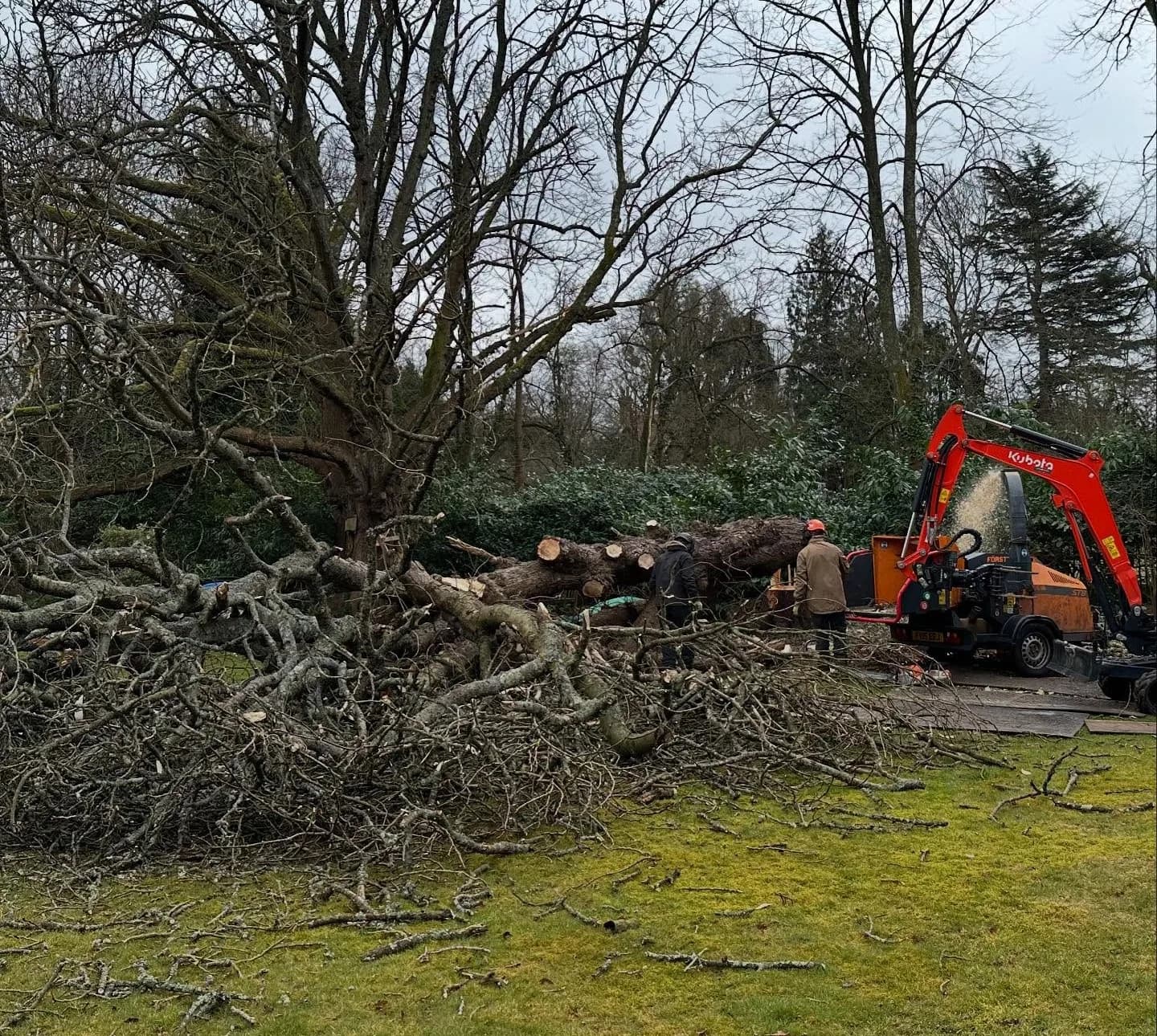
Ash affected by dieback is not always a straightforward climbing job. As condition worsens, the timber can become more fragile and less predictable. That changes how the work should be approached.
What matters to the customer is simple: the removal or reduction needs to be done safely and without turning a disease issue into a site accident.
That can affect:
- access planning
- method of dismantling
- whether climbing is appropriate
- how the drop zone is managed
- how the site is left afterwards
Protected trees still need the right process
One reason people delay is concern about permissions. That is understandable. Some affected ash trees are protected or stand within conservation areas. But the presence of restrictions does not mean the problem should be ignored.
The better approach is to:
- assess the tree honestly
- document the concern properly
- work through the permission route if needed
- avoid both panic and drift
Where a diseased ash is clearly deteriorating in a risk-sensitive location, it is far better to deal with that through the right process than wait until failure forces the issue.
Replanting matters too
Losing mature ash is a real change to a site. It can affect privacy, shade, screening, and the feel of the landscape. That is why removal should often be followed by a conversation about what comes next.
Depending on the location, replanting may help restore:
- structure to the garden or boundary
- long-term screening
- visual balance
- habitat value
The replacement does not need to be immediate, but it is worth thinking about the site beyond the removal itself.
If the ash was part of a mixed boundary, removing it often exposes hedging that has been growing unchecked in its shade for years. Cutting back laurel hedges that have been left to spread once a screening tree comes down is a common follow-on job, and it is worth tackling at the same time so the new boundary line settles in cleanly rather than looking patchy for another season.
What property owners should do
If you have an ash tree in Surrey or the surrounding area and you are concerned about its condition, the most useful steps are:
- do not assume it is fine because it is still standing
- do not assume every infected ash must come down immediately
- look at where the tree stands and what it could hit
- get advice before the decline becomes a crisis
Ash dieback is now a normal part of tree management in many parts of the South East. The goal is not panic. It is making sensible, timely decisions so weakening ash trees are dealt with before they become a bigger safety issue than they needed to be.
What Ash Dieback Means For Your Tree
Not every ash with dieback needs to come down immediately. The practical question is how far the decline has progressed and how close the tree is to things that matter. Assessment before action is nearly always the right call.
When To Pick Up The Phone
- When an ash tree is losing crown or dropping small branches
- When you are not sure whether the tree can stay or needs to come down
- When you want an honest assessment rather than a worst-case quote
Useful Next Pages
Need Advice On A Tree?
Practical help for Sussex and Surrey properties
If you are trying to work out whether a tree needs pruning, reduction, removal, or just sensible advice, Capel can look at the site and tell you what makes sense.
Guides like this are written and checked in-house by people who actually do the work. See our editorial policy for how we keep them accurate.