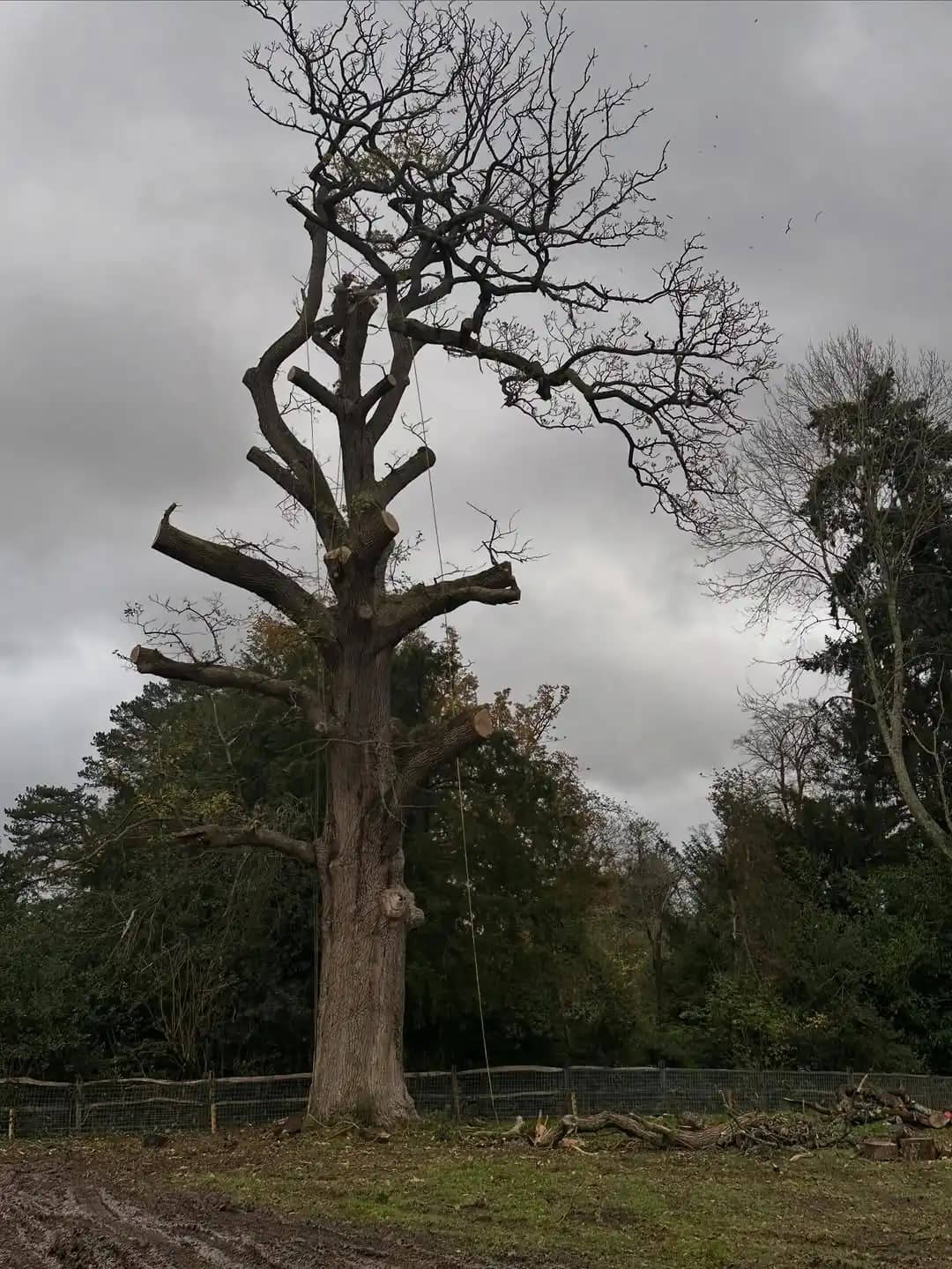
Quick Summary
Protected oak trees need careful handling. The right approach means understanding the restrictions and the tree's condition before any work begins.
Large oak trees are often among the most important features on a property. They bring age, character, shade, and a sense of permanence that younger planting simply cannot replace. They can also be the trees that cause the most uncertainty when something starts to feel wrong.
That uncertainty becomes even greater when the oak is protected by a Tree Preservation Order or sits within a conservation area. People often know there are rules, but they are not always clear on what they can do, what they need permission for, or whether their concern is serious enough to justify making an application.
Why protected oaks need a careful approach
Oak trees are often retained precisely because they are valuable to the wider setting. That value may be visual, historic, ecological, or simply because the tree is a major feature in the landscape.
At the same time, mature oaks can create very practical concerns:
- heavy limbs over drives, roads, or gardens
- overhang close to roofs or neighbouring land
- deadwood in the crown
- signs of decline or decay
- shade and dominance on smaller plots
When a protected oak starts causing worry, the answer is not to ignore it and hope for the best. Nor is it to assume the council will refuse all work. The right approach is to assess the tree properly and then work out what is both reasonable and defensible.
What a Tree Preservation Order actually means
A Tree Preservation Order does not mean a tree can never be touched. It means protected work must be considered through the right process.
In simple terms, that usually means:
- you should not carry out pruning or removal on your own initiative
- the local authority may need to approve the proposed work first
- the reasons for the work should be clear and sensible
- the specification needs to be appropriate rather than excessive
For a homeowner, that can feel intimidating. In practice, what matters is whether the proposed work is justified and presented properly.
The first question should be: what is the actual issue?
People often jump straight to "Can I cut it back?" before clarifying what the real concern is. With protected trees, that is the wrong order.
The better starting point is:
- is there deadwood that needs attention?
- is there a clear safety issue?
- is a branch over-extending or rubbing?
- has the canopy become too dominant for the setting?
- is the concern about light, clearance, or long-term management?
The clearer the actual problem, the easier it is to decide whether work is justified and what sort of work is proportionate.
Not every concern leads to major pruning
This is important. Sometimes the owner fears the oak needs drastic work when a lighter touch would be more appropriate. In other cases, the concern may be understandable but not strong enough to justify significant cutting.
Protected oak management may involve:
- removing deadwood
- light reduction on specific limbs
- lifting for clearance
- managing end weight on selected branches
- monitoring rather than immediate pruning
The point is not to make the tree smaller at all costs. It is to respond to the actual issue without taking more from the tree than the site genuinely needs.
Veteran and mature trees should not be treated like ordinary pruning jobs
Older oaks deserve more thought than a routine "cut it back" instruction. Their age, structure, visual importance, and habitat value all matter. A veteran or long-established oak can rarely be approached in the same way as a fast-growing ornamental tree in a tighter suburban garden.
That does not mean nothing can be done. It means the work should be more deliberate.
Good management may involve:
- preserving the natural shape as much as possible
- avoiding harsh cosmetic pruning
- taking a phased approach where appropriate
- reducing risk without stripping the tree of its character
Why paperwork and communication matter
One reason protected tree jobs go wrong is that people treat them like a simple quote-and-cut exercise. They are not. The work often needs clear reasoning, a sensible written description, and a standard of communication that shows the proposal has been thought through.
That matters because the decision is not only about the tree owner. It is also about the council officer reviewing the request and whether the proposed work sounds measured, justified, and appropriate.
Poorly framed requests can make reasonable work look excessive. Good preparation improves the chances of getting to the right outcome without unnecessary delay.
Safety concerns should still be taken seriously
Some people hesitate to raise concerns about protected trees because they assume protection status means they are stuck with the risk. That is not the right way to think about it.
If there is:
- major deadwood
- obvious failure or cracking
- a damaged limb over a target area
- a significant change in the tree's condition
then that should be assessed properly. Protection does not remove the need for sensible management. It just means the process needs handling correctly.
The best outcome is usually balanced, not aggressive
With protected oaks, the strongest result is usually a balanced one. The tree is respected, the legal side is handled properly, and the practical concern is dealt with in a way that is proportionate.
That might mean a modest amount of work rather than a dramatic cut. It might mean targeted pruning rather than broad reduction. It might even mean confirming that no immediate work is needed and that monitoring is the better course for now.
Either way, the value comes from clear advice and a sensible plan, not from rushing into visible cutting.
If you are unsure, start with assessment rather than assumptions
If you have a mature or protected oak in West Sussex and you are concerned about safety, overhang, light, or general condition, the first step is not trying to interpret the rules on your own or guessing what work will be allowed. It is getting the tree looked at properly. A tree survey covers exactly this: condition, risk, permission requirements, and what work is actually justified.
That gives you a far better chance of understanding:
- whether work is justified
- what sort of work makes sense
- what the likely permission route is
- how to protect both the tree and your own position as the property owner
Protected trees need more care in both senses of the word. If the oak has structural concerns beyond routine pruning, the oak tree conservation service page covers what that work involves. The right outcome is usually the one that respects the tree, the site, and the rules at the same time.
Protected Trees Need A Clear Process
Most clients dealing with protected trees are not looking for theory. They want to know what work is likely to be acceptable, whether permission may be needed, and how to move forward without making the wrong call first.
When To Pick Up The Phone
- When a large oak is protected or in a conservation area
- When the concern is light, clearance, overhang, or safety rather than full removal
- When you need practical advice before any work is booked
Questions People Ask
How do I find out if my oak tree has a Tree Preservation Order?
Check with the local council's TPO register, most West Sussex councils publish an interactive map online, or Capel can check it as part of a site visit before any work is planned. See our Tree Preservation Orders guide for the full process.
Can a protected oak be pruned at all, or only removed with permission?
Routine work like deadwooding, crown lifting, or a measured reduction is often still allowed under a TPO. Consent is about controlling what happens to the tree, not banning all work on it. Full removal without consent is where the serious penalties apply.
What happens if a protected tree is removed without consent?
It's a criminal offence with fines that can run into tens of thousands of pounds, and the council can require a replacement to be planted. Always check status before booking any oak work in a conservation area or TPO zone.
Need Advice On A Tree?
Practical help for Sussex and Surrey properties
If you are trying to work out whether a tree needs pruning, reduction, removal, or just sensible advice, Capel can look at the site and tell you what makes sense.
Guides like this are written and checked in-house by people who actually do the work. See our editorial policy for how we keep them accurate.